
Airports Weren't Designed for 1 in 5 of Their Passengers. Here's What Changes.
The tannoy crackles with a gate change. A child screams somewhere near the coffee stand. Fluorescent light bounces off polished floors, and increasingly it’s LED, brighter than what it replaced despite using less energy, with a flicker rate too fast for most people to consciously register but not too fast for their nervous system to. A queue of a hundred people shuffles forward in no particular rhythm. For most travellers, this is background noise. For a significant share of the people walking through it, it’s an assault on the senses that starts the moment they clear security and doesn’t let up until they’re in their seat.
Airports have spent the last decade redesigning themselves around premium comfort: better lounges, better seating, better food. Almost none of that redesign has accounted for the fact that a large proportion of passengers experience the terminal itself as the hardest part of the journey.
The Numbers Airports Can’t Ignore
Neurodivergent individuals, people with autism, ADHD, dyslexia, dyspraxia and related conditions, make up roughly 15–20% of the population. That’s not a niche accessibility case. That’s a meaningful share of everyone who walks through a departure hall.
The demand data backs this up, and it’s rising fast. In 2024, approximately 5.5 million passengers requested assistance at UK airports, around 1.9% of all travellers, up from 1.69% in 2023 and just 0.94% in 2010. That’s roughly double the rate in under fifteen years, with no sign of levelling off.
The impact of getting this wrong is severe. Up to 90% of autistic people experience sensory differences, and in one survey, 59% of passengers with disabilities said they experienced difficulties navigating airports. For families, the consequences show up long before departure day: one Autism Travel survey found 87% of families with autistic children avoid travel altogether, largely because of sensory overload and a lack of appropriate space once they arrive.
That’s not an accessibility statistic. That’s lost footfall, lost retail spend, and lost loyalty, for every airport still treating this as a niche concern.
Where the Industry Has Started, But Isn’t Finished
Credit where it’s due: some airports are responding. A small number in the US have opened dedicated post-security sensory rooms, with dimmed lighting, soft seating and mock boarding areas to help travellers acclimatise before a flight. It’s a genuine step forward.
But the coverage is thin. In the UK, research suggests only three of seventeen major airports currently offer a sensory room at all. For every other terminal, the options remain the same as they’ve always been: a busy gate, a crowded lounge, or nothing.
And even where a sensory room exists, it’s usually a single, fixed space: one room, in one location, for an entire terminal’s worth of demand. It doesn’t scale with passenger numbers, and it doesn’t travel with the person who needs it, whether they’re at security, by the gate, or waiting out a delay three hours later on the other side of the building.
The Real Problem: Shared Space Can’t Be Sensory-Controlled
A single calming room solves the problem in one spot, at one moment. It doesn’t solve the deeper issue, which is that almost every square metre of a modern terminal is designed as shared, high-stimulus space: bright, often harshly so, as airports switch to energy-efficient LED lighting that trades comfort for cost savings, loud, unpredictable, and built for throughput rather than calm.
What actually helps isn’t a nicer waiting room. It’s a private, self-contained environment the traveller can step into on their own terms, wherever they happen to be in the terminal, for as long as they need it.
Where Kabin Comes In
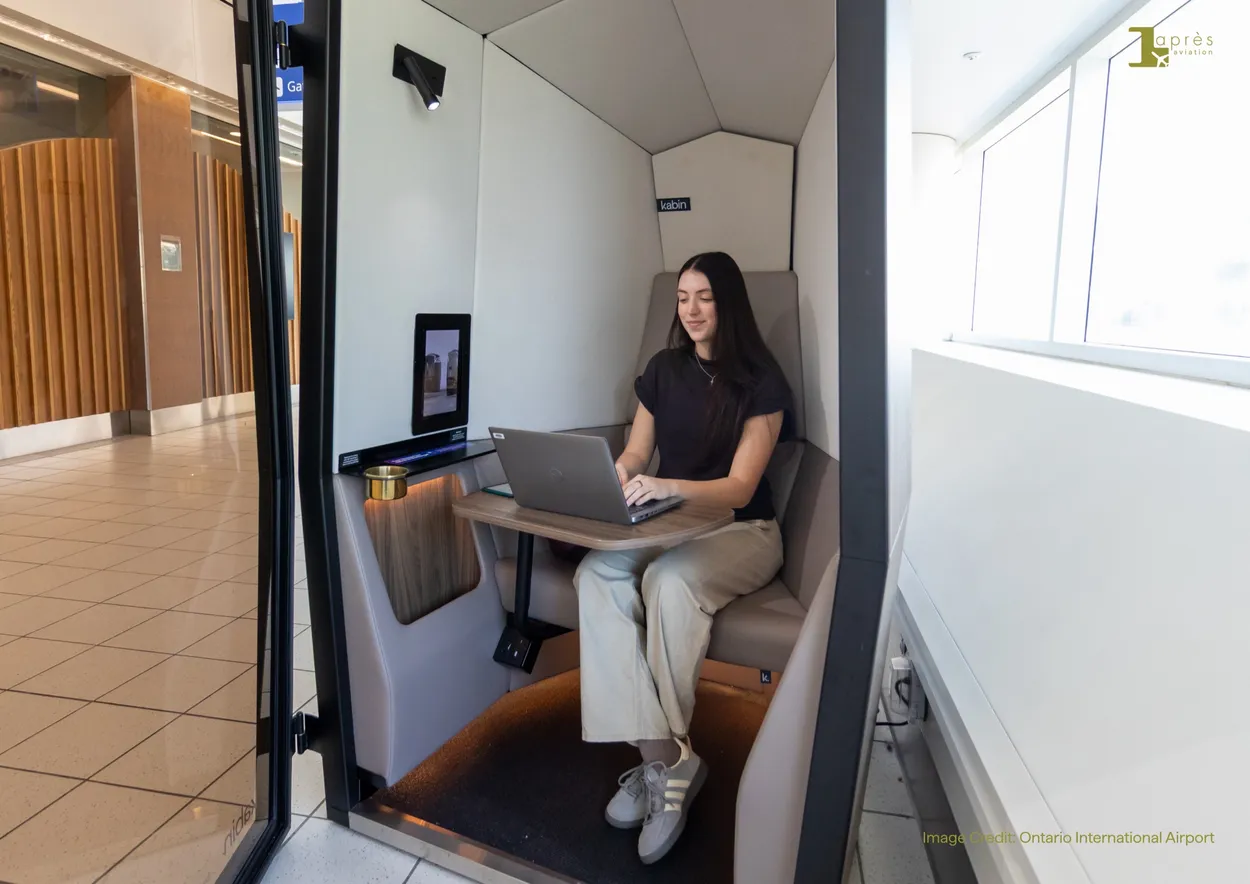
Kabin by Après Aviation is a modular private pod built for exactly this kind of environment. Where a terminal is unpredictable by design, Kabin offers a self-contained space that isn’t: consistent acoustic isolation, adjustable, flicker-free lighting the traveller controls themselves, and a fully enclosed environment, rather than one dictated by whoever else happens to be nearby.
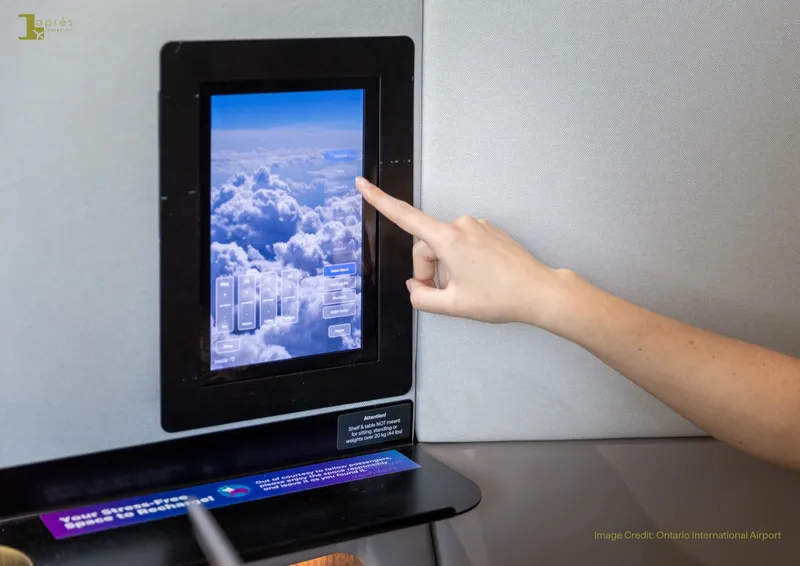
What makes this genuinely different from a plain quiet room is choice. Inside every Kabin pod is an integrated screen offering a range of immersive ambient scenes (ocean, fireplace, even a view from a plane window), each paired with its own matching soundscape rather than a single generic “calm” setting. For a neurodivergent traveller, that matters more than it might first appear: sensory regulation isn’t about the absence of stimulus, it’s about control over it. The same crackling fire or rolling ocean that helps one traveller settle might do nothing for another, so the ability to choose, and change, the environment is the difference between a pod that merely blocks out the terminal and one that actively helps a traveller self-regulate.
For a neurodivergent traveller, that difference matters enormously. It’s not about escaping the airport experience entirely. It’s about having somewhere to reset for ten minutes, or an hour, on their own terms, without needing to find the one dedicated room in the building, or leave the airport altogether.
For operators, it means this kind of support doesn’t have to mean one fixed room in one corner of one terminal. Kabin’s modular format means multiple units can be deployed exactly where the need is: near gates, in transit zones, throughout the terminal, rather than concentrated in a single space that most passengers will never be near when they actually need it.
Airports weren’t built with a fifth of their passengers in mind. That’s not a permanent condition. It’s a design choice that hasn’t caught up yet. The airports that fix it first won’t just be doing right by their passengers. They’ll be capturing the loyalty of a group the rest of the industry is still treating as an afterthought.
Sources
- Doyle, N. (2020), British Medical Bulletin
- UK Civil Aviation Authority, Airport Accessibility Performance Report 2024/25
- Autistica
- CAA 2023 UK Aviation Consumer Survey
- IBCCES/Autism Travel survey
- Altogether Travel (2022)